
New Hanover County Supervision Types
Three labels often get combined in casual speech, but North Carolina treats them as separate legal statuses. Probation is usually imposed by a court as part of a judgment. A person can begin probation without first serving a state-prison term. Post-release supervision, often shortened to PRS, follows specified prison sentences under Structured Sentencing. Parole generally concerns older cases or other narrow groups that remain eligible under the governing law. The North Carolina Department of Adult Correction, or NC DAC, administers Community Supervision. The North Carolina Post-Release Supervision and Parole Commission makes the decisions assigned to it by statute.
A release from New Hanover County Detention Facility on bond is not proof of any of these statuses. The person may instead be monitored by New Hanover County Pretrial Release Services while the criminal case continues. That county program attends first appearances, supplies verified information to judicial officials, monitors court-ordered conditions, and reports violations to the court. It is not state parole or probation, and it does not show that a sentence has been completed.
| Status | How it starts | Primary verification |
|---|---|---|
| Probation | A court imposes community-based conditions in a judgment | Court judgment and the NC DAC supervision record |
| Post-release supervision | A qualifying state-prison term reaches release from confinement | NC DAC status, actual release information, and supervising office |
| Parole | The Commission approves release in a parole-governed case | Commission decision plus NC DAC actual release and status |
| Pretrial release | A judicial official permits release while a case remains pending | New Hanover court record and county pretrial program when applicable |
- Discharge
- The end of the applicable custody or supervision term.
- Absconder
- A person formally reported by the supervising authority as avoiding supervision or whose whereabouts are unknown.
- Detainer
- A request or hold from another authority that may affect custody or release.
New Hanover County Pretrial Release
New Hanover County Adult Enhancement Services operates Pretrial Release Services as a court support path. Staff attend first appearances, provide verified information to judicial officials, assess release conditions, monitor people released before trial, and report alleged violations to the court. The county publishes 910-772-6791 for the Adult Community Service Office and 910-798-7556 for the AES director. Staffing names can change, so the office is a safer contact than an old employee listing.
A person monitored through this program has left jail under a court order while the case remains open. That fact does not create a DAC probation, parole, or post-release supervision record. Verify the bond and conditions through the New Hanover County court record and clerk. If the case later ends in a probation judgment, the NC DAC supervision entry and District 5 office become the relevant state sources.
Check New Hanover County Post-Release Status
The statewide NC DAC Offender Public Information search is the main public starting point for state probation, parole, and post-release supervision. It covers people who entered DAC prison custody or participated in state Community Supervision. It does not cover a person whose only event was release on bond from the New Hanover County jail. Search by the seven-digit DAC number when it is known. Otherwise, compare the name result with birth date, aliases, convictions, admission history, and county details before opening a record.
The detailed record may show labels such as Probation/Parole/Post Release Status, Probation/Parole Office, Incarceration Status, Actual Release Date, parole begin and end dates, Current Status, and Last Movement Date. Keep those labels intact. An active supervision field can confirm that the person is out of prison yet still under DAC authority. An inactive result is broader than a recent release and needs the sentence and supervision history for context.
- Search the DAC record by offender number, or use the name and enough identifiers to avoid a false match.
- Read the incarceration status and Actual Release Date before deciding that prison custody ended.
- Identify the exact supervision label. Do not substitute parole for probation or post-release supervision.
- Record the listed Probation/Parole Office or District 05 unit and contact the office for current operational confirmation.
- Compare the filed New Hanover court judgment or Commission decision when the source of the status matters.
- Use NC SAVAN as a notice layer, not as a substitute for the agency record.
Important: A missing entry in the NHSO P2C jail roster does not establish supervision. The person may have left county custody on bond, transferred, or entered another agency's custody.
New Hanover County District 5 Office
New Hanover and Pender counties share NC DAC Community Supervision Judicial District 5. This local arrangement is the practical link between an active public record and the unit that manages the case. A DAC detail screen can name a more specific District 05 unit, so the district address should not be treated as proof that every supervised person reports at the same desk. Have the full name and DAC number ready. Ask which unit currently holds the record and whether the public status is current.
NC DAC Community Supervision District 5
721 Market Street, Suite 102
Wilmington, NC 28401
910-251-2701
Fax: 910-251-5694
State administration: 919-716-3100
The official directory is useful when a public record shows active supervision but the unit label is unclear. It does not make confidential case notes public. North Carolina law protects underlying Community Supervision records, so ask for a public status or routing confirmation rather than private addresses, risk assessments, or internal violation details.
The DAC directory displays the community supervision office network used to route New Hanover County cases.
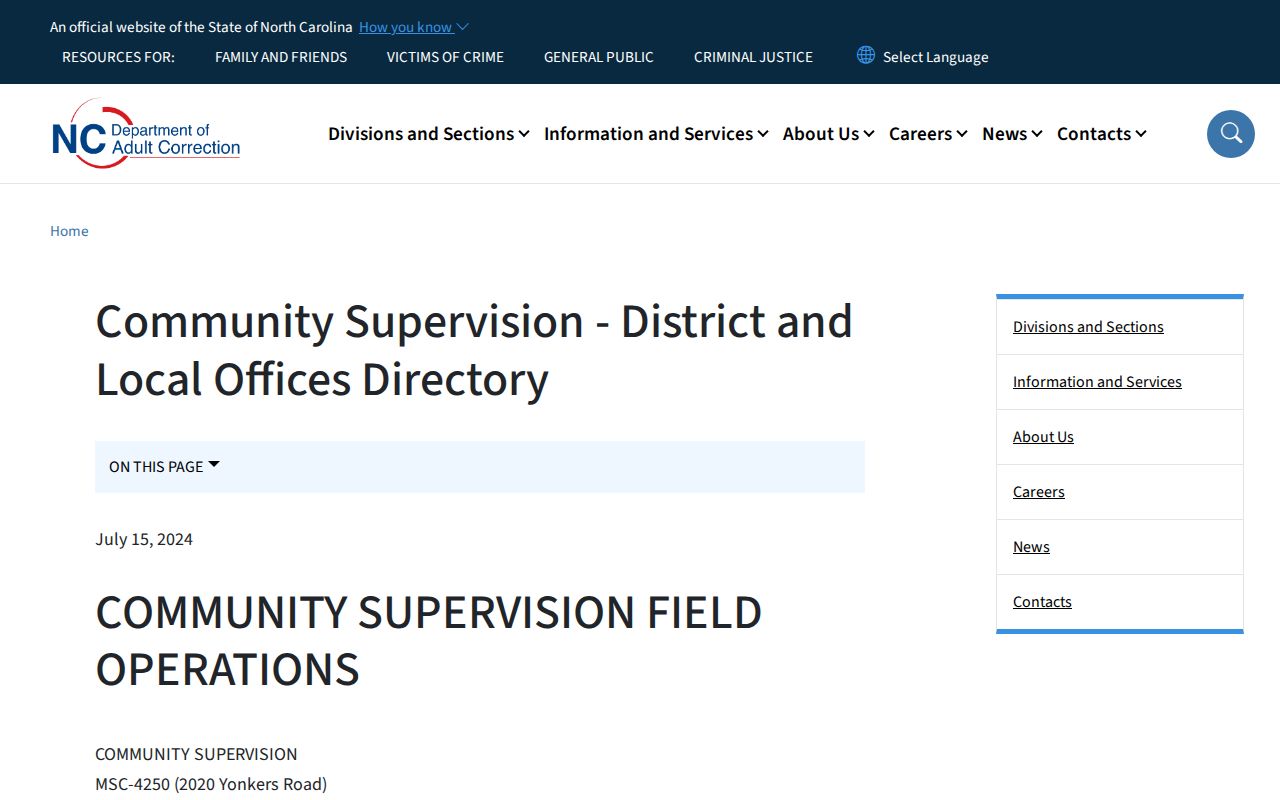
Note: Office assignment can change, so confirm the unit shown on the current DAC record before relying on an older contact.
New Hanover County Absconder Records
A missed appointment, rumor, or stale address does not prove that someone has absconded. Use the official NC DAC absconder search. An entry reports that the supervising authority alleges willful avoidance of supervision or does not know the person's whereabouts. It does not prove rearrest, and it is not the same as a warrant. A warrant is a separate court or agency instrument.
Compare an absconder result with the general offender record, then contact the office identified there. Court records may show a filed violation report, an order for arrest, a hearing, or a later disposition. The New Hanover Clerk of Superior Court can supply filed copies when exact language matters. NC SAVAN may report custody events for a registered person, but it does not replace the court document or the DAC status. Avoid guessing about the nature of an alleged violation from a short public label.
New Hanover County Parole Case Review
The Post-Release Supervision and Parole Commission does not publish a conventional New Hanover County hearing calendar. Its parole work is generally an administrative case-review process. Ordinary discretionary parole was largely replaced for offenses committed on or after October 1, 1994, though older and specially governed cases remain. Eligibility depends on the offense date, sentence regime, conviction, exclusions, and current law. A simple calculation cannot settle it.
The Commission's monthly Discretionary Parole Reviews page publishes review and decision spreadsheets beginning with September 2024. It is a decision-reporting layer, not an in-person hearing schedule. Terms can include Incomplete Decision, Suspend Decision, Regular Parole, Community Service Parole, Early Medical Release, and 90-day Mandatory Parole. Use the exact recorded term. Eligibility or review does not equal approval, and approval does not establish that the person has left prison.
The official parole process explains the Commission's role and how eligible cases are considered.
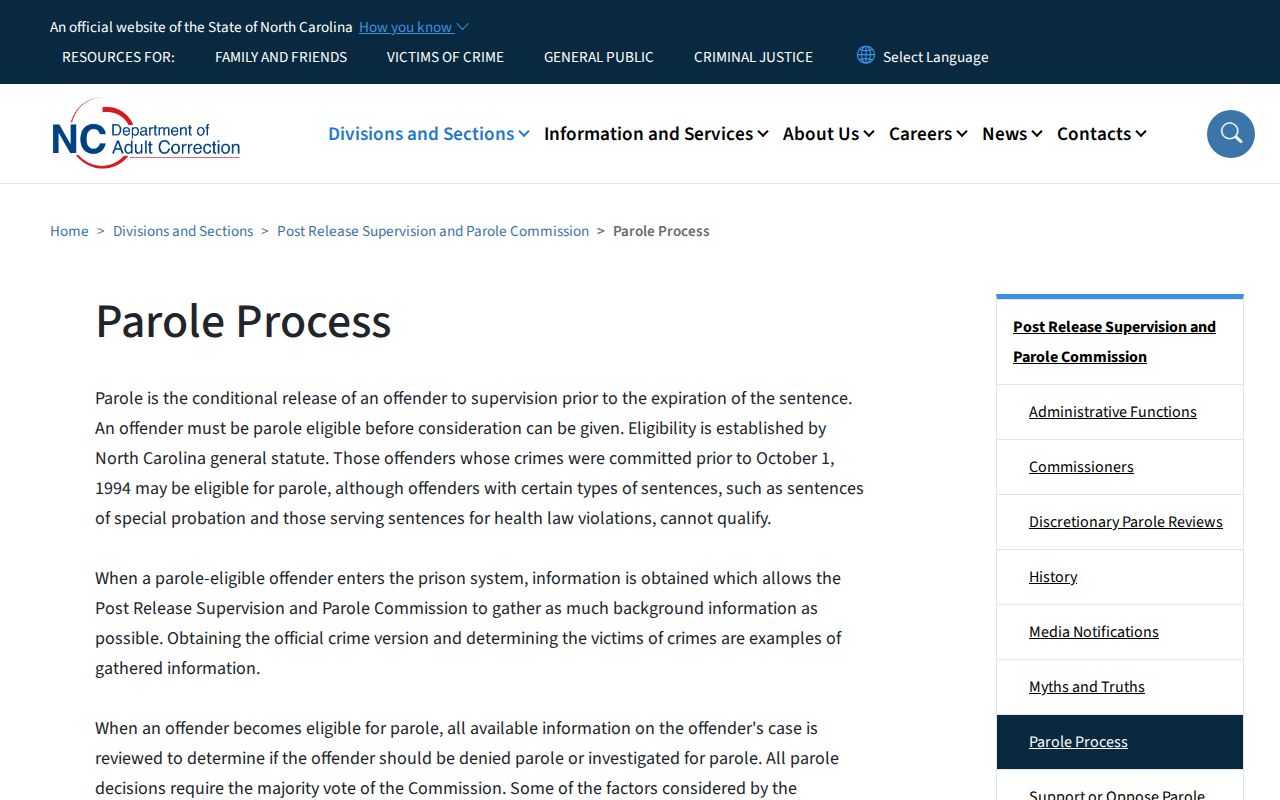
That distinction keeps a review outcome from being mistaken for physical discharge or the end of a supervision term.
New Hanover County Supervision Discharge
Conditions come from the judgment, statute, Commission action, and supervising authority. They can address reporting, approved residence or travel, programs, financial duties, and conduct, but the actual order controls. Public summaries are not a sound basis for assuming what applies to one person. A supervising officer handles operational questions. Filed court orders address probation changes, while Commission and DAC records govern parole or post-release status.
Supervision may end through successful completion, a lawful early termination, expiration under the governing rules, revocation, or another formal action. A prison Actual Release Date does not by itself show that supervision ended. For post-release supervision, completion can terminate the sentence from which that supervision began. Preserve both the custody-release date and the later discharge event. The broader New Hanover County released-inmate search and records path explains how to request the underlying county release or transfer record when the person first left the detention facility.
Probation violations return to the court process. Parole and post-release matters can involve the Commission and DAC. New Hanover County Pretrial Release Services reports alleged violations to the court but remains a separate local program. Those paths should never be blended into one generic “parole violation” label.
Note: Verify an end date with the current agency record because release from confinement and discharge from supervision are separate events.
New Hanover County Supervision Notifications
North Carolina Statewide Automated Victim Assistance and Notification, or NC SAVAN, is delivered through VINELink and by phone at 1-877-627-2826. It can report selected custody changes from NC DAC and participating county jails. For a state prisoner, notices may include projected release after the admission audit, release with supervision, or release without supervision. Each notice concerns the reporting contributor. It does not prove that all custody or supervision ended.
Search the exact person, compare identifiers and agency, and register from that record. A phone registrant creates a PIN to acknowledge a call. If the call is not acknowledged, state policy provides for repeat attempts at set intervals for 24 hours. Registration is confidential. Use the notice to prompt a check of the DAC record and District 5 office, especially when a release alert is followed by an active supervision label.