
Juvenile Detention Release Paths
New Hanover Regional Juvenile Detention Center is a state juvenile justice facility serving the region. Juvenile detention is not the same as an adult county jail sentence or an adult state prison term. A youth may leave under a juvenile court order, return to a parent or authorized guardian, move into a supervised placement or program, or transfer within the juvenile justice system. The permissible details depend on the case and the requester’s legal relationship.
Physical departure also must be separated from the legal case. A court order may authorize a change in detention while conditions, hearings, services, or supervision continue. The party entitled to information should preserve the exact court and agency terms instead of translating them into adult labels such as parole, inmate discharge, or jail release.
The regional nature of the center matters. A youth can live in one county, have a case in another, and be held at this facility. Determine the county and court with jurisdiction before requesting a record. Physical location alone does not identify the proper clerk or juvenile justice contact.
Confirm Juvenile Detention Release
There is no responsible public adult-search shortcut. NHSO P2C lists adult county custody, while NC DAC Offender Public Information covers adult state correctional custody and supervision. Neither should be used to infer a juvenile’s detention, release, identity, or destination. NC SAVAN and the adult sex-offender registry also are not general juvenile release ledgers.
- Identify the court and county that control the juvenile matter. Do not assume it is New Hanover merely because the center is physically in the region.
- Contact the responsible juvenile court or Division of Juvenile Justice and Delinquency Prevention channel.
- Explain the legal relationship to the youth and the narrow reason confirmation is needed.
- Follow identity, guardianship, counsel, consent, and case-number requirements given by the agency or court.
- Ask whether detention ended, whether a transfer occurred, and what follow-up information may lawfully be disclosed.
- Keep any information within the access and confidentiality limits attached to it.
A lack of public search results says nothing about whether a youth is detained or released. Confidentiality is a design feature of the juvenile system, not missing data that should be filled from private posts, adult databases, or name-based speculation.
Juvenile Release Record Access
North Carolina public-record law does not erase specific juvenile confidentiality rules. Chapter 132 provides general access principles, but a more specific law protecting juvenile information controls. A requester should not demand an adult-style entry/release summary, mugshot, charge grid, or transfer list without first establishing lawful access.
Ask for the least amount of information needed. A parent, guardian, lawyer, or other authorized person may be directed to a case-specific process. The agency may require proof of identity, relationship, representation, or a court order. Some information may be disclosed only to parties or their counsel. Other portions may remain confidential even when the requester knows the youth’s name and date of birth.
Do not use an ordinary county public-record portal to bypass the juvenile court or juvenile justice custodian. If that portal receives a misrouted request, it may only redirect or deny it. Begin with the authority named in the case documents whenever possible.
General North Carolina public-record principles do not displace a more specific juvenile confidentiality rule. The fact that an adult arrest detail, booking image, or release summary might be requested under Chapter 132 does not create an equal right to a youth’s record. The authorized route may allow only confirmation of a narrow event, may require a court order or proof of representation, or may limit the response to the party and counsel. Follow those limits even if similar adult information appears online.
County of residence, county of the case, and facility location must be kept separate. The regional center’s New Hanover location does not establish that the New Hanover clerk controls the matter. A lawful requester should use the case number, court notice, placement paper, or counsel’s information to identify jurisdiction before contacting an office. This prevents disclosure requests from reaching the wrong county and avoids treating a regional placement as a local adult booking.
Juvenile Center Record Contacts
New Hanover Regional Juvenile Detention Center inquiries
Responsible authority: North Carolina Division of Juvenile Justice and Delinquency Prevention or the juvenile court with jurisdiction
Adult roster route: not applicable
Adult DAC offender search: not applicable
Research did not establish a facility public release desk, public counter schedule, or general phone line for publishing juvenile release status. Do not invent one. Use the contact contained in the youth’s court or placement paperwork, or ask the juvenile court in the county of the case to identify the correct authorized route.
When New Hanover County is the proper court location, the New Hanover Clerk of Superior Court is at 316 Princess Street, Wilmington, NC 28401, phone 910-772-6600, with courthouse hours normally Monday through Friday from 8 a.m. to 5 p.m. The clerk can explain process and access limits but may not disclose a confidential juvenile file to an unauthorized caller.
New Hanover Juvenile Court Records
The North Carolina Portal resources explain public Smart Search and Case Summary tools.
Public adult criminal portal access should not be interpreted as permission to search or republish confidential juvenile cases. A juvenile matter may not appear through the same public view, and a blank public result confirms nothing.
The official courthouse page provides the New Hanover clerk location and contact.
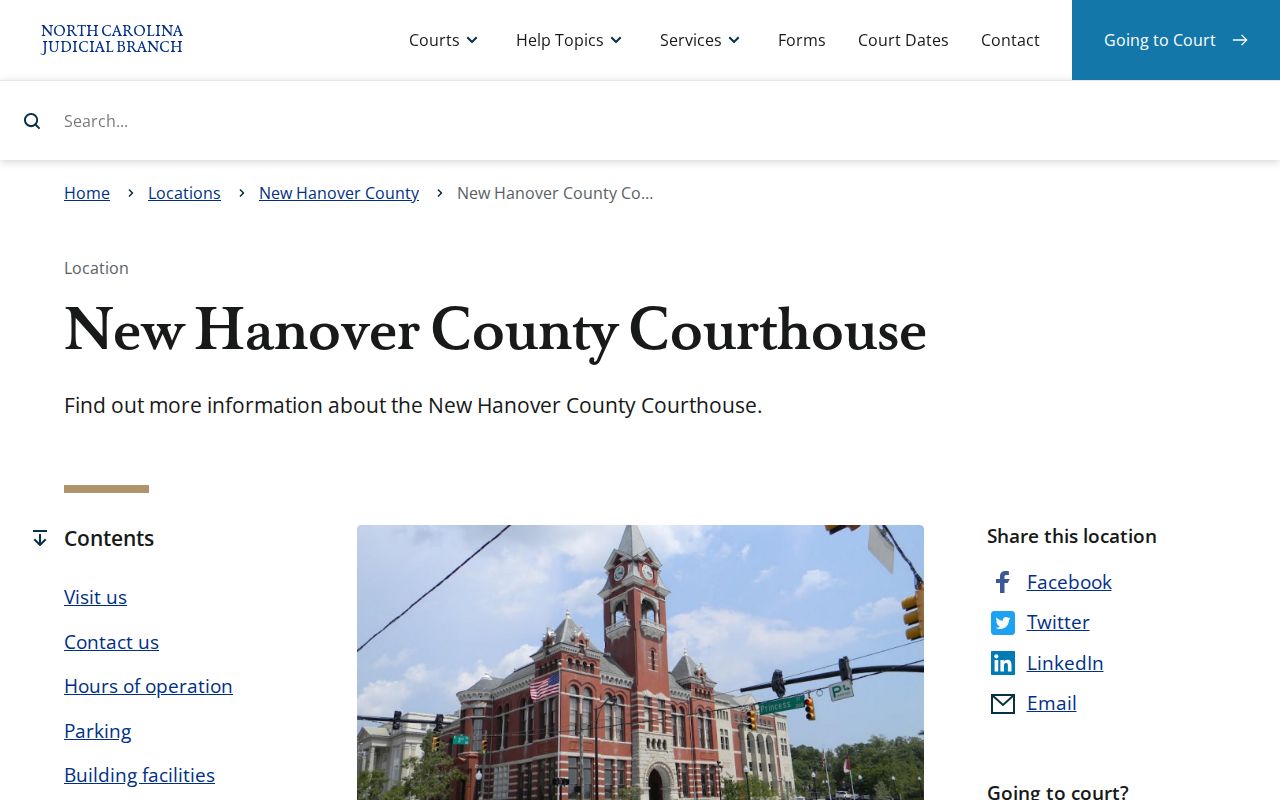
The courthouse is a process contact only when New Hanover is the county of the juvenile case. It is not evidence that every youth housed at the regional center has a New Hanover court file. The Judicial Branch also explains its general court-record copy process, subject to the confidentiality and access rules governing the particular juvenile matter.
New Hanover Juvenile Center
The center is operated within the state juvenile justice system and may serve youths from across a region. Its population, legal authority, case records, and release decisions belong to juvenile processes. Adult terms can create harmful errors. “Inmate,” “mugshot,” “parole,” and “adult offender record” should not be mapped onto a youth merely because those terms appear elsewhere on a released-inmates site.
No public capacity figure, booking count, release cadence, records fee, guaranteed response time, or open release list was established in the assigned research. Those details are therefore not supplied here. A public absence should not be filled with generic jail facts or statistics from the adult New Hanover County Detention Facility.
Juvenile detention status can change rapidly through court action and placement decisions. Only the responsible authority can explain what a particular lawful requester may learn and whether a stated departure was release to a guardian, placement, or transfer.
A blank adult search is expected and has no evidentiary value here. P2C is the sheriff’s adult county-custody inquiry, and DAC’s public offender system concerns adult correctional custody and supervision. The SBI registry has its own narrow legal scope. None can confirm that a youth was ever held at the regional center, show when the youth left, or identify an authorized destination. The absence of a result should end the public search and return the inquiry to the responsible juvenile authority.
Protect Juvenile Release Privacy
Do not create a public list of youths who left this facility. Do not search adult mugshot sources, private aggregators, social media, or news archives to reconstruct confidential detention history. A photograph or name match can misidentify a child, expose protected information, and lose the case context that the juvenile court is required to safeguard.
Share lawfully obtained details only with people entitled to receive them and only for the purpose that justified access. Store case numbers, contact information, and court papers securely. When uncertain, ask the juvenile court or counsel what can be disclosed instead of assuming that general open-record rules override juvenile confidentiality.
Adult search boundary. P2C, the adult DAC offender search, adult release lists, mugshot discovery, and the adult registry are not tools for identifying a juvenile release from this center.
Juvenile Versus Adult Releases
| Question | Juvenile center route | Adult route that does not substitute |
|---|---|---|
| Who confirms departure? | Authorized juvenile justice or juvenile court contact | NHSO P2C |
| Where is the record? | Confidential case or agency system, subject to access rules | Adult sheriff release history |
| Does state DOC search apply? | No, not as a juvenile release lookup | NC DAC adult offender information |
| Can a public mugshot be expected? | No | Adult booking-photo channels |
| Does facility county control? | Not necessarily; determine county of case | Assuming New Hanover from physical location |
This separation is essential. The adult New Hanover County release guide applies to adult custody systems only. It should not be used to bypass the protections governing this regional juvenile facility.
Public Record Search
Sponsored Results